
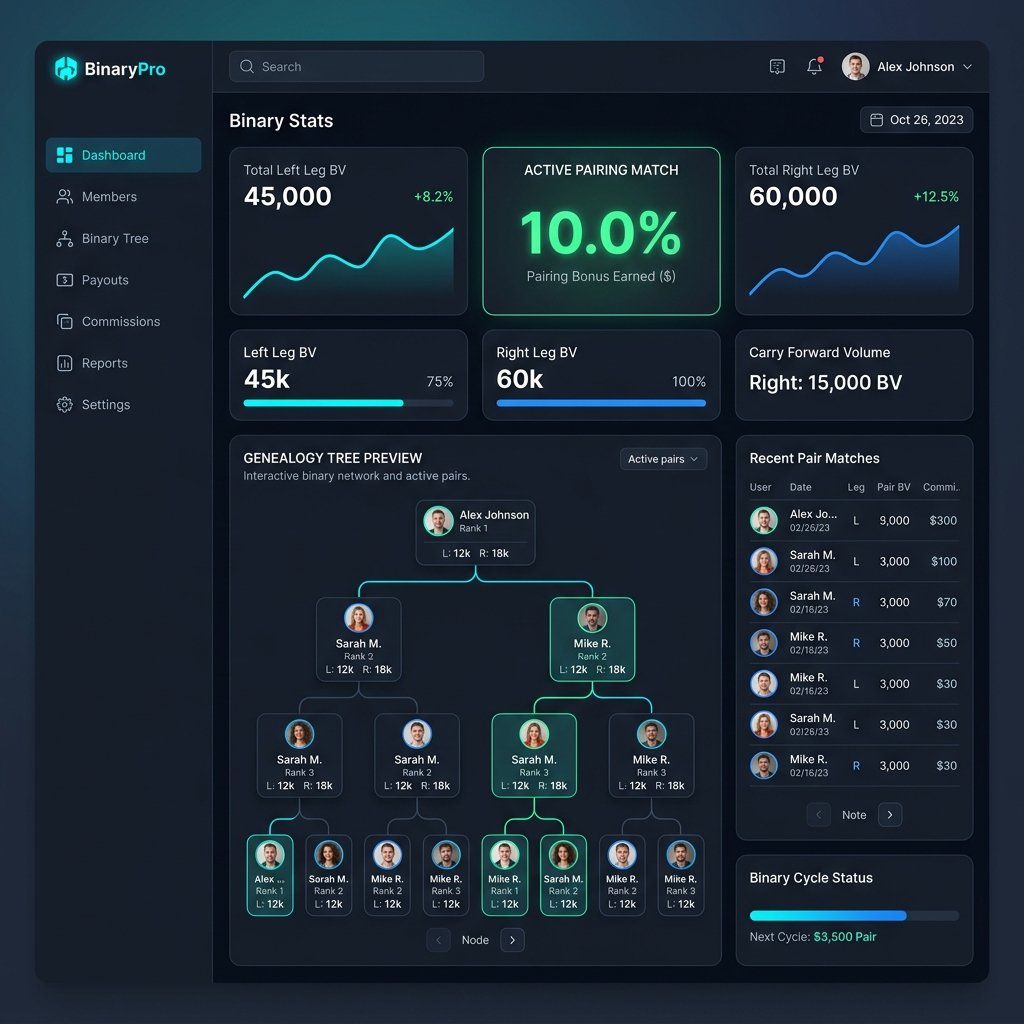
The Binary MLM plan is one of the most widely used and successful multi-level marketing structures in India. Known for its simplicity, fast growth potential, and teamwork-promoting nature, it requires each distributor to recruit and manage two direct legs: the Left Leg and the Right Leg. In this ultimate guide, we will break down the mechanics, payout structures, benefits, and critical challenges of the Binary plan.
Key Takeaways
- ✓ The Binary MLM plan places distributors into two primary subtrees: Left Leg and Right Leg.
- ✓ Pairing bonuses are calculated as a percentage of Business Volume (BV) in the weaker pay leg.
- ✓ Spillover lets active sponsors place new direct signups in their downlines legs.
- ✓ Pairing caps are mandatory to avoid payout ratios exceeding total brand revenues.
1. The Structure of a Binary MLM Plan
In a binary network marketing organization, every node or position has exactly two child nodes directly beneath it. If a member recruits more than two people, the additional recruits "spill over" into the downline of the existing left or right subtrees. This structural spillover motivates sponsors to assist their downline members, fostering strong collaboration.
Need MLM Software Development?
Talk to our direct selling architects to build a secure, high-concurrency MLM system tailored for your compensation plan.
Spillover is the secret weapon of Binary MLM structures. It creates a cooperative environment where senior leaders actively build downline legs for their recruits.
2. How Binary MLM Commissions are Calculated
Commissions are based on Business Volume (BV) or Point Value (PV) generated by the weaker leg (commonly called the "pay leg"). Here is how the payout works:
Binary Spillover Placements Logic Flow
- Pairing Ratio: Usually, the pairing ratio is 1:1 or 2:1/1:2. In a 1:1 ratio, a commission is triggered whenever equal business volume is accumulated on both sides (e.g., 100 BV on Left and 100 BV on Right).
- Capping: To prevent company insolvency, companies set a daily or weekly limit on payouts, known as "capping." This ensures the payout percentage does not exceed revenue margins.
- Carry Forward: Any unpaid volume on the stronger leg is carried forward to the next billing cycle.
Amit Sharma
LinkedIn ProfileDirect Selling Systems Architect & Software Engineer
Expert in high-concurrency database locking, double-entry financial ledgers, auto-spillover placement logic, and blockchain Web3 smart contract audits with over 8+ years of custom MLM development experience across India.